Empowering Creativity: How AI is Reshaping the Fashion Landscape
Google's Strategic Entry into Fashion Technology: A Creative Collaboration
Following its successful ventures in the film industry, Google's Envisioning Studio has now turned its innovative gaze towards the dynamic world of fashion. In anticipation of New York Fashion Week, Google initiated key collaborations with esteemed designers Jane Wade and Sergio Hudson. This partnership aims to introduce and rigorously test two specialized AI-driven tools: an advanced AI styling suite designed for meticulous pre-show preparations and a sophisticated runway visualization tool crafted for intricate show staging. These beta-mode tools are being developed under the umbrella of Google's Flow AI creative studio, marking a significant step in integrating artificial intelligence into the core creative processes of fashion.
The Philosophy Behind AI Development: Co-creation with Creatives
Yeawon Choi, the lead user experience designer at Google’s Envisioning Studio, articulates the fundamental principle driving their initiatives: technology must be forged in collaboration with creatives, rather than merely being imposed upon them. This co-design approach ensures that the tools developed are genuinely helpful and intuitive for their users. Across diverse creative sectors, including both fashion and film, Google has identified common challenges—namely, the critical need for effective pre-visualization, the unrelenting pressure of tight deadlines, and severe resource limitations. These shared friction points form the bedrock of Google's AI development strategy, aiming to provide practical solutions that alleviate these industry-wide burdens.
Revolutionizing Pre-Show Styling: Jane Wade's AI Styling Suite
Jane Wade's partnership with Google has resulted in the digitization of one of the most labor-intensive aspects of fashion show preparation: the styling and finalization of each individual runway look. Traditionally a process consuming countless hours, Wade’s team can now leverage their co-developed AI styling suite to rapidly visualize garments in an array of colorways, fabric textures, and styling combinations. This capability allows them to make informed decisions before committing to the expensive production phase. Wade highlights the immense value for small businesses like hers, where resource optimization is paramount. The ability to pre-visualize a look digitally can prevent costly errors, potentially saving thousands of dollars at the manufacturing stage.
Enhancing Creative Experimentation and Cost Efficiency in Styling
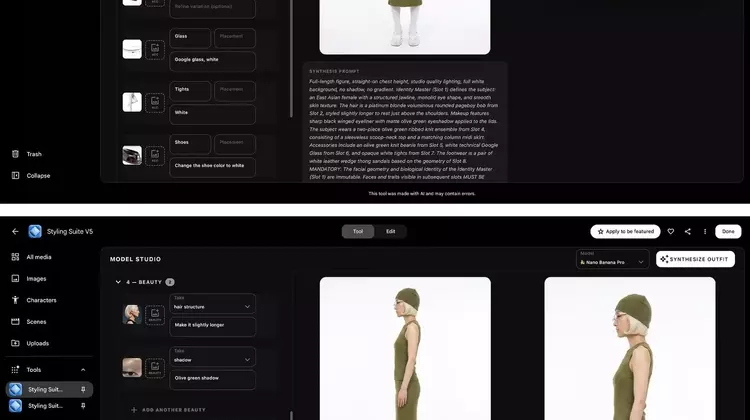
The AI styling suite provides designers with the flexibility to experiment with various fabrics and colors, enabling a more iterative and refined design process. This innovative approach allows for backward design—testing concepts digitally before physical samples are produced, thereby avoiding the disappointment and cost associated with unsatisfactory physical prototypes. A key feature of this generative AI tool is its memory function, which allows designers to upload past collections, brand photography, and beauty lookbooks. This extensive dataset trains the styling suite, empowering designers to explore a wider spectrum of styling possibilities and maintain brand consistency.
Streamlining Model Preparation: Automated Styling Visualizations and Model Cards
Beyond initial garment visualization, Wade collaborated with Google to integrate pre-fitting styling visualizations into the AI suite. This feature enables Wade and her stylist to collaboratively experiment with accessories, eyewear, and comprehensive beauty directions, including hair and makeup. These elements can be digitally layered onto images of actual cast members captured during fittings, allowing for dynamic experimentation with new collection items. The tool generates diverse outputs, such as full looks, headshots, and detailed shots, mimicking professional dressing cards. Wade emphasizes that this tool is a supplement, not a replacement, for physical fittings, ensuring every look is still physically tried on models before final approval.
The Role of AI: An Accelerator, Not a Creative Author
Wade also worked with Google to create an automated model card generator, simplifying a previously complex Adobe Illustrator-based workflow into a user-friendly interface. This innovation enables team members with limited Adobe proficiency to produce print-ready dressing cards that meet precise pre-show specifications, maintaining brand visual language and perceived luxury. Wade estimates that this tool helped her avoid re-cutting styles, primarily benefiting internal visual alignment across her team. However, she notes that core garment production costs—pattern-making, materials, and labor—remain beyond AI’s current scope.
Industry Sentiment: AI as a Tool, Not a Replacement for Human Creativity
Despite her embrace of technology, Wade firmly believes AI serves as a process accelerator rather than a creative author, reflecting a broader industry perspective. While AI discussions dominate fashion boardrooms, designers themselves approach its integration into the creative process with caution. Many are open to using AI for back-end tasks like finance and legal, or as a cultural subject. However, concerns about intellectual property—what happens to proprietary work fed into AI models and its potential for generating similar outputs elsewhere—make most designers hesitant to incorporate AI directly into core creative design.
Preserving Authenticity: The Human Touch in Final Production
Wade draws a clear boundary: the final image must involve real people, in a physical studio, with professional photographers and stylists. This stance underscores a commitment to human artistry and authenticity in the ultimate presentation of fashion. The industry largely values the irreplaceable human element in crafting the final visual narrative, ensuring that while AI can optimize preliminary stages, the soul of fashion—its artistry and emotional resonance—remains firmly in human hands. This balance ensures that technology augments creativity without diminishing its intrinsic human value.
Transforming Runway Staging: Sergio Hudson's AI Visualization Tool
Sergio Hudson’s primary challenge in show production revolved around staging. He collaborated with Google to develop an AI tool that simulates every aspect of a show venue, from dimensions and lighting to mood and prop placement, all within predefined budget parameters. This innovative solution empowers Hudson to refine the entire runway environment digitally before committing to the substantial expenses of physical construction. By avoiding costly last-minute alterations, the tool significantly enhances efficiency and financial control, allowing for greater creative freedom within budgetary constraints.
Overcoming Traditional Staging Obstacles with AI Precision
Hudson explains that translating a collection's mood and spatial flow into a physical venue traditionally involves extensive trial and error. This often necessitates expensive physical builds or high-cost outsourced 3D renderings, followed by numerous revisions exchanged with production crews. The hope is that the final setup aligns with the designer's vision upon arrival at the venue. However, issues with lighting or proportions on-site often lead to costly, real-time alterations. The AI runway visualization tool eliminates these uncertainties by allowing precise digital adjustments, ensuring the final physical build accurately reflects the designer's detailed vision.
Empowering Creative and Financial Control in Runway Production
The AI runway visualization tool provided Hudson with the capability to fine-tune intricate details, such as lighting moods and model movement within the venue, through high-fidelity images. This precision instilled confidence, enabling him to make significant changes—like reordering collection looks and adjusting set elements—digitally. Hudson emphasizes the financial control offered by the platform, which tracks costs while allowing for dozens of spatial iterations. This ensures capital is never committed to staging or lighting designs that are financially unviable, thereby expanding creative possibilities by mitigating the fear of expensive mistakes.
Fostering Risk-Taking and Protecting Creative Energy for Independent Designers
Hudson notes that for independent designers, every design revision or mock-up sent to production carries a real price tag, which naturally leads to playing it safe and defaulting to familiar setups. The financial risk associated with experimentation often drains creative energy, as designers spend considerable bandwidth managing logistics, venue constraints, and production costs. This AI tool, however, protects creativity by restoring that bandwidth, allowing designers to focus on their craft. It helps independent labels bridge the perception gap, enabling them to inject risk-taking into staging for a polished look, even with smaller budgets. Although the AI tool has limitations in capturing the full "energy, environment, and silhouette" of a runway, Hudson, like Wade, plans to continue refining and integrating it into his pre-production processes for future shows.